How Dragons Took Shape Across the Ancient World
From water deities in the East to hoarding beasts in Western folklore, draconic myths reflect humanity’s deepest natural fears and observations.
Draconic creatures appear across the folklore of cultures throughout the world, yet the beasts imagined by different civilisations could hardly look or behave more differently [1]. In ancient Mesopotamia, dragons took both hostile and protective forms; in East Asia, they became auspicious water deities associated with rainfall and the throne; and across medieval Europe, they were largely cast as subterranean, fire-breathing embodiments of wickedness and greed [1][2][3].
Scholars have long debated where the universal impulse to invent such monsters originated [1]. Hypotheses range from innate primate instincts to ancient fossil beds and early observations of weather patterns [1]. Despite their varied forms, almost all early attested depictions share a foundational outline: an oversized serpent adorned with traits borrowed from other powerful beasts [1].
The serpent root and primeval combat
The English word dragon entered the language in the early 13th century from the Old French dragon, which derives through Latin draco from the Ancient Greek drákōn, meaning serpent [1]. In antiquity, the Greek and Latin terms often referred to any great snake rather than a purely mythological creation [1]. The Greek word is linked to the verb dérkomai, meaning “I see”, pointing towards creatures with a piercing glance or the permanently open appearance of serpentine eyes [1]. Old English texts such as Beowulf used draca as well as wyrm, denoting a slithering, crawling reptile rather than the four-legged heraldic beasts seen centuries later [1][2].
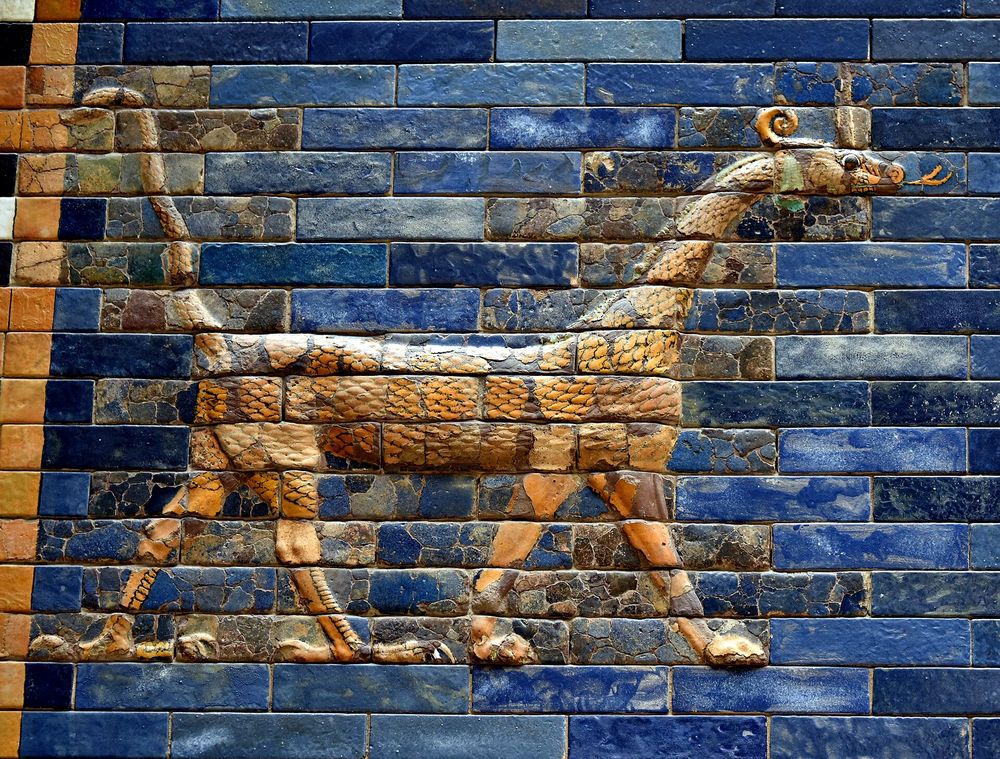
Early Near Eastern and Mediterranean traditions established a recurring motif: the storm deity or culture hero battling a massive serpent [1]. In Egyptian mythology, the sun god Ra descended into the underworld each night to battle Apep, a giant serpent whose roars were thought to cause thunderstorms and earthquakes [1]. Ancient Levantine texts from Ugarit describe the sea-dragon Lōtanu, while the Hebrew Bible depicts Leviathan, an aquatic adversary slain by Yahweh [1]. In ancient Mesopotamia, art from the Akkadian period onwards featured the mušḫuššu, a horned creature combining the body and neck of a snake, the forelegs of a lion, and the hind-legs of a bird, which served as an attendant and protective emblem for major deities such as Marduk [1].
Sovereigns of water and imperial emblems
In East Asia, draconic figures developed an entirely distinct spiritual character [1]. Chinese dragons, known as long, were generally revered as auspicious beings who governed moving bodies of water, rainfall, and drought [1][3]. Premodern villages frequently maintained shrines to local Dragon Kings, turning to them with communal offerings during periods of flood or dry spells [3].
From the Han dynasty onwards, the dragon became intimately tied to Chinese imperial authority [1][3]. Han founder Liu Bang claimed to have been conceived after his mother dreamt of a dragon, and later dynasties strictly regulated the motif [3]. By the Yuan, Ming, and Qing dynasties, the five-clawed dragon was reserved exclusively for the emperor [3]. Physical descriptions reflected an assembly of powerful animals; according to the Han dynasty scholar Wang Fu, the creature exhibited nine anatomical resemblances, including the antlers of a stag, the head of a camel, the neck of a snake, the scales of a carp, and the claws of an eagle [3]. Unlike their Western counterparts, East Asian dragons were rarely shown with wings, their capacity to fly and ascend to the clouds being treated as inherently mystical [3].
The Western beast of the cavern
In the European tradition, dragons grew increasingly associated with malevolence, underground lairs, and hoards of treasure [1][2]. While Greek mythology featured guarding serpents such as Ladon and the Hydra, Roman concepts later fused Greek serpents with Near Eastern iconography [1][2]. Christian scripture, particularly the Book of Revelation’s depiction of Satan as a great dragon with seven heads, reinforced the creature’s identification with cosmic evil [2].
By the Middle Ages, Western lore developed the familiar continental dragon: a scaly, horned, lizard-like monster sporting bat-like wings, sharp claws, and the ability to breathe fire [1][2]. Medieval narratives regularly pitted holy figures against rapacious monsters, as in the widely circulated account in the 13th-century Golden Legend, where Saint George rescues a town by wounding and subduing a dragon that demanded human sacrifices [2]. By the late Middle Ages, heraldry began making formal distinctions among these beasts, classifying two-legged winged creatures as wyverns and four-legged specimens as true dragons [2].
Theories of origin
Why disparate cultures imagined such similar composite monsters remains a subject of academic study [1]. In his book An Instinct for Dragons (2000), anthropologist David E. Jones suggested that humans inherited evolutionary fears of ancestral predators—specifically snakes, large cats, and birds of prey—combining them into a single terrifying figure [1]. Jones noted that dragons typically inhabit deep pools, caves, mountain reaches, and wild forests, environments fraught with danger for early human ancestors [1].
In The First Fossil Hunters (2000), folklorist Adrienne Mayor argued that discoveries of prehistoric animal remains also fed these traditions [1]. In China, large Cenozoic fossil mammal bones were historically identified as “dragon bones” and used in traditional medicine, while northern Indian lore may have drawn upon large fossils from the Siwalik Hills [1][3]. However, Mayor noted that fossils alone cannot explain every tradition, observing that Scandinavia produced rich dragon lore despite long being considered barren of large prehistoric remains [1]. Anthropologist Robert Blust offered an alternative in The Origin of Dragons (2000), proposing that traditional dragon concepts arose from rational pre-scientific attempts to explain natural phenomena, specifically the mechanisms governing rainfall, drought, and rainbows [1]. Whether born of primal predator instincts, unrecognised fossils, or atmospheric wonders, the draconic form provided a flexible language across centuries for articulating the awesome powers of the natural world [1].