Red Rocks: How Natural Geology Shaped a Music Landmark
Framed by ancient sandstone monoliths, Colorado's open-air amphitheatre evolved from an acoustic wonder into one of the world's most storied stages.
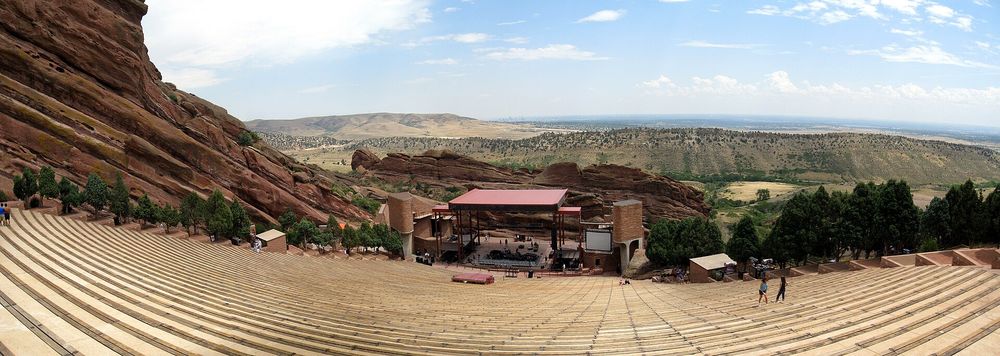
Perched 1,970 metres (6,450 feet) above sea level in the foothills southwest of Denver, Red Rocks Amphitheatre owes its reputation as a premier live venue to geological forces that unfolded hundreds of millions of years ago, according to Wikipedia[1][2]. Two towering sandstone monoliths—named Ship Rock and Creation Rock—alongside the smaller Stage Rock, form the acoustic and visual frame of the 9,525-capacity open-air theatre near Morrison, Colorado[1].
Long before modern staging equipment was hauled up the slope, the natural acoustic properties of the canyon attracted performers, according to Wikipedia[1]. The site’s transformation into an international concert landmark spans geological shifts, early 20th-century visionary schemes, Depression-era federal works, and decades of rock and roll lore[1][2].
Ancient Stone and Early Shows
The red sandstone outcrops at the site belong to the Fountain Formation, produced between 290 and 296 million years ago when the Ancestral Rocky Mountains eroded during the Pennsylvanian epoch, according to Wikipedia[2]. Millions of years later, tectonic upheaval during the Laramide orogeny lifted and tilted the slabs into the dramatic diagonal formations visible today, their reddish hue caused by oxidized minerals[1][2].
Historically used by the Ute tribe, the area was encountered by an Army expedition led by Stephen Long in 1820, according to Wikipedia[1][2]. Marion Burts recorded the first private ownership of the land in 1872 before selling it to civil engineer Leonard H. Eicholtz in 1878, who laid early roads, trails, and picnic grounds[1][2]. In 1906, magazine publisher John Brisben Walker bought the site with proceeds from his sale of Cosmopolitan[1]. Walker renamed it the “Garden of the Titans” and erected a temporary platform for musical performances[1].
The earliest documented concert occurred on 31 May 1906, when Pietro Satriano led a 25-piece brass band for Walker’s grand opening[1]. Word of the site’s natural resonance spread, and on 10 May 1911, Scottish opera singer Mary Garden performed on the mountain[1]. Impressed by the natural resonance between the monoliths, Garden praised the venue’s singing environment, according to Wikipedia[1]:
“Never in any opera house, the world over, have I found more perfect acoustic properties.”
Building the Modern Amphitheatre
In 1927, George Cranmer, manager of Denver Parks, persuaded the City of Denver to acquire the park from Walker for $54,133, according to Wikipedia[1]. Denver completed the formal purchase in 1928, officially adopting the long-standing local name “Red Rocks”[1][2]. Cranmer and Denver Mayor Benjamin Stapleton then set about constructing a permanent civic amphitheatre[1].
Denver architect Burnham F. Hoyt, working alongside Stanley E. Morse, designed the structure to sit directly within the natural sandstone cradle, according to Wikipedia[1]. Labour and materials were supplied under New Deal programmes by the Civilian Conservation Corps (CCC) and the Works Progress Administration (WPA), with construction commencing in 1936[1]. A dedicated CCC camp established at Mount Morrison built out the amphitheatre, roads, and a Pueblo-style concession building[2].
The finished open-air theatre was formally dedicated on 15 June 1941 with a performance by operatic soprano Helen Jepson, and regular annual concert seasons began in 1947, according to Wikipedia[1]. In recognition of its architecture and preserved New Deal origins, Red Rocks Park and the surviving Mount Morrison CCC camp were designated a National Historic Landmark on 4 August 2015[2].
Turbulence and Tradition on the Rocks
Over the subsequent decades, the natural venue played host to a wide range of musical history, according to Wikipedia[1]. Igor Stravinsky conducted the Denver Symphony at the site on 23 July 1948, and pianist Van Cliburn played to a sell-out audience in 1958[1]. On 26 August 1964, The Beatles made their debut at Red Rocks, marking the only non-sellout show of their American tour[1]. Drummer Ringo Starr noted the physical challenge of the venue’s altitude, recalling that the air was thin and musicians were supplied with oxygen canisters, according to Wikipedia[1].
Rock performances faced a sudden halt following a Jethro Tull concert on 10 June 1971, according to Wikipedia[1]. After roughly 1,000 ticketless fans converged outside the venue and clashed with police, tear gas drifted across the ridge and onto the stage, leading Denver Mayor William H. McNichols Jr. to ban rock concerts at the venue[1]. For five years, only softer musical acts were permitted until promoter Barry Fey challenged the policy in court, winning a ruling that the city had acted arbitrarily; rock acts officially returned in the summer of 1976[1].
The venue subsequently became a favourite recording location for live music and concert films, according to Wikipedia[1]. U2’s rain-soaked 5 June 1983 concert produced the acclaimed concert film Live at Red Rocks: Under a Blood Red Sky, while bands like The Grateful Dead made the venue an essential touring stop, playing 20 shows there between 1978 and 1987[1]. Widespread Panic went on to set the venue record, achieving 72 sell-out performances at Red Rocks by June 2024[1].
Industry recognition followed the venue’s growth; Pollstar magazine honoured Red Rocks as the best small outdoor venue eleven times before renaming the accolade the “Red Rocks Award” in 1999 and taking the amphitheatre out of future contention, according to Wikipedia[1]. In 2021, Red Rocks was recorded as the top-grossing and most-attended concert venue of any size in the world, maintaining its position as an extraordinary union of natural architecture and live performance[1].