From Earth to Stone: The Rapid Evolution of Medieval Castles
Born of feudal fragmentation, castles shifted from quick timber mottes into layered stone fortresses before gunpowder rendered them obsolete.
European castles were never mere military garrisons. As Wikipedia’s survey of medieval fortifications notes, scholars define the castle as “a private fortified residence” belonging to a feudal lord or monarch, setting it apart from communal walled towns or Roman military forts [1]. Over six centuries, castle architecture transformed steadily, developing from rapid earthen dykes into complex stone rings in direct response to changing weapons, siege methods, and political needs [1][3].
The collapse of empire and the rise of mottes
The European castle emerged across the Loire and Rhine valleys during the 9th and 10th centuries [2]. Following the splintering of the Carolingian Empire, individual princes and lords faced raids from the Magyars and the Norse without central state protection, prompting local rulers to establish private strongholds to secure their territory and assert authority [1][2].
The earliest widespread design was the motte-and-bailey, which spread rapidly across northern France, the Holy Roman Empire, and the Low Countries [2]. It combined two distinct elements: an artificial or scarped mound of earth known as a motte, topped with a timber keep and palisade, alongside an adjoining enclosed courtyard or bailey [1][2]. The bailey formed the hub of daily domestic and economic life, accommodating kitchens, workshops, stables, barracks, and stores [2].
Mottes proved militarily formidable while remaining relatively easy to erect with unskilled, forced labour [2]. While stone keeps of the era typically took up to ten years to construct, contemporary estimates suggest larger earth mounds required between four and nine months of labour, and smaller sites could be completed far more rapidly [2]. The sheer volume of soil moved was immense; historians estimate the motte at England’s Thetford Castle demanded as many as 24,000 man-days of work [2]. However, only 7% of surviving mottes in England and Wales exceeded 10 metres (33 ft) in height, with the vast majority—69%—measuring less than 5 metres (16 ft) tall [2].
William the Conqueror made extensive use of this rapid construction method following the Norman Conquest of 1066, establishing 36 castles across England by 1087, including Warwick Castle, to secure occupied regions and check potential rebellions [1].
Moving from timber to stone keeps
Despite their practical advantages, timber structures carried an inherent flaw: vulnerability to fire [3]. Defenders occasionally coated wooden fortifications with animal hides to mitigate flame attacks during sieges, but stone soon became the preferred building material across northern Europe [1][2].
As masonry took over, the central great tower—often called a “donjon” in contemporary sources, an ancestor of the modern word dungeon—became the focal point of security [1]. At first, particularly under Norman rule in England where conquerors lived in constant readiness, the keep served simultaneously as a defensive citadel and the lord’s primary domestic hall [1]. These stone towers contained multiple storeys: basements held granaries and cellars, middle floors provided grand residential halls, and higher levels housed sleeping chambers [1][2].
Flanking fire and concentric walls
By the late 12th and 13th centuries, castle architecture shifted from single keeps to sophisticated external curtain walls [1][3]. Advancements in attacking equipment, particularly the widespread use of heavy trebuchets capable of battering masonry, forced master masons to rethink structural geometry [3].
Rectangular keeps produced blind angles at each corner where attackers could mine beneath the walls without coming under defensive fire. Builders responded by rounding castle towers and designing curtain walls that featured projecting bastions to support overlapping flanking fire [1][3].
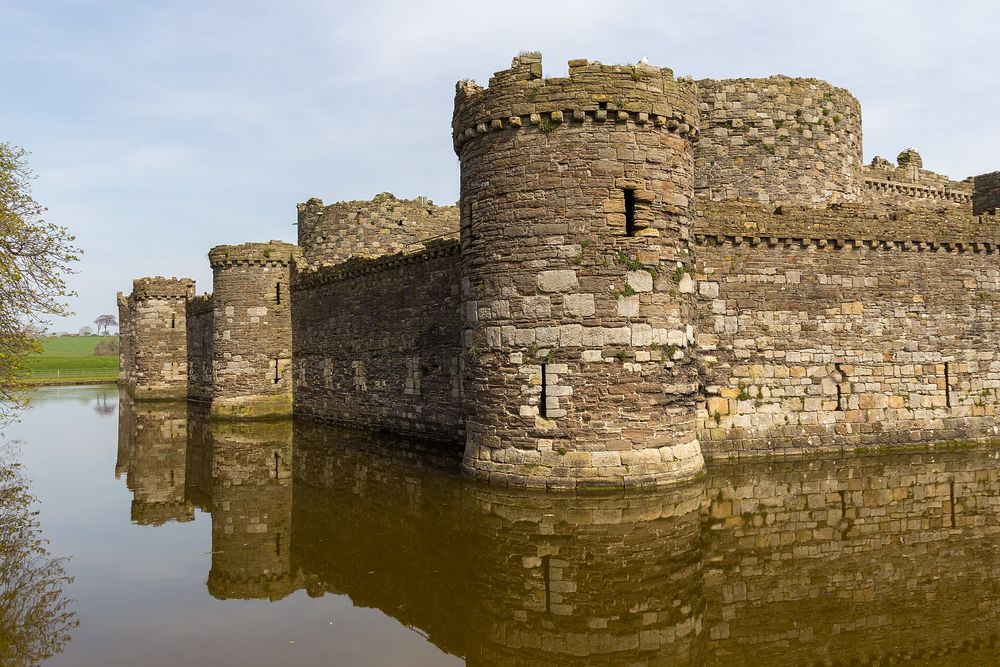
This culminated in the concentric castle, a design that drew on Byzantine and Roman fortifications encountered during the Crusades [1]. Concentric designs, such as Beaumaris Castle in North Wales, placed one ring of curtain walls directly inside another [1][3]. The inner walls rose higher than the outer circuit, permitting defenders on both tiers to loose arrows and fire simultaneously at an approaching army without obstructing one another [1].
The fall of stone fortifications
Curtain walls thickened over time, frequently reaching between 2.5 and 6 metres (8.2 to 19.7 ft) across, with defensive battlements featuring machicolations—overhanging stone chutes through which defenders dropped heavy objects or boiling liquids [1][3]. Many sites harnessed waterways, diverting local streams to establish wide defensive moats, flooded ditches, and defended docks that permitted waterborne resupply during prolonged sieges [1][2][3].
Yet the decisive end of the medieval castle came with developments in gunpowder. Although gunpowder arrived in Europe in the 14th century, its tactical impact remained limited until artillery grew strong enough to shatter high vertical stonework during the 15th century [1]. As heavy cannons became commonplace, vertical stone towers made vulnerable targets [1][3]. To withstand bombardment, defensive military architecture moved away from residential castles toward low-profile artillery star forts with angled earthwork bastions [1]. The noble elite gradually abandoned damp, heavily fortified citadels in favour of unfortified country houses and châteaux, bringing an end to the castle’s combined role as private residence and military stronghold [1].